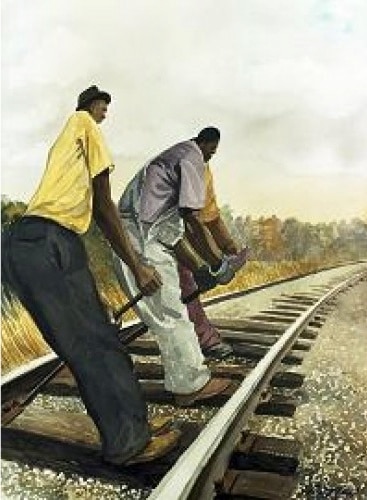
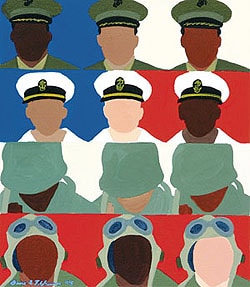
For this Artists in Restaurants, arts contributor Jeff Schaller interviews Dane Tilghman in Coatesville’s Little Chef Restaurant.
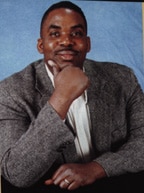
I walked into Little Chef Restaurant in Coatesville and past the lunch counter to find a seat in the main dining room. I have driven by this little family restaurant many times but only noticed the retro chef guy on the sign, never thinking I would stop in for a bite. Today was different. I was stopping in for lunch to meet artist/entrepreneur Dane Tilghman. I sat down and pulled my weighty wooden chair up to the table to wait for Dane’s arrival. This was my first time meeting Dane, so I wasn’t sure what to expect. I soon found out that he is a big guy with an inner glow that radiates out from his eyes and smile. At first glance, I would say he looks like the typical intimidating big guy, but really he is as kind and courteous as a true gentleman.
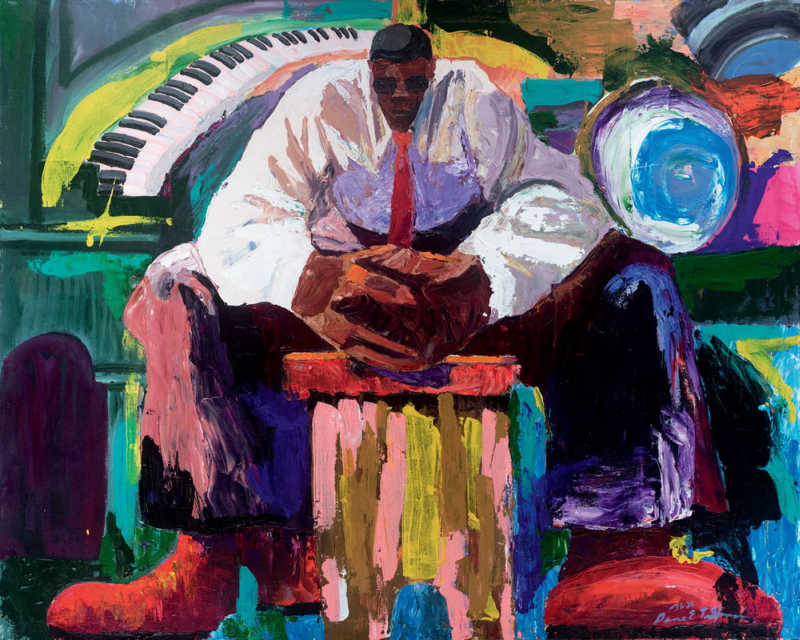
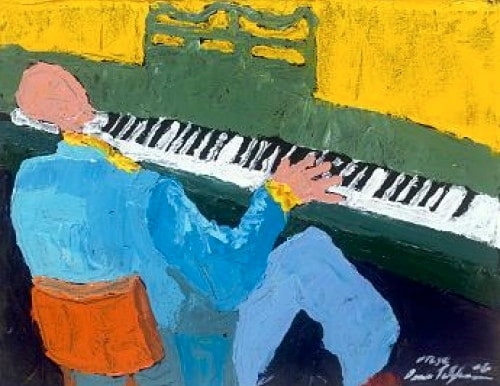
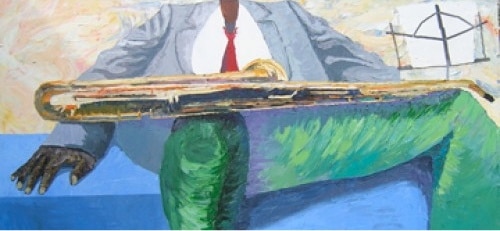
More surprising was the content of his character. He possesses a deep love and passion for all that is close to his heart. A family man, he realized while working for his father at a young age that he didn’t want the “9 to 5 thing.” He had his mind set on being an artist. Come what may, he was going to support his wife and two children through the brilliance of his brush. With a pallet of styles and colors, he set out to capture his family and heritage on canvas. After mastering realism, he had reached a state of boredom. Pushing himself to do better and fueled by his passion for happiness, he broke free with an elongated Cubism inspired folk art. Tilghmanʼs totally fantastic style can capture blues players and Negro baseball players and present them to the everyday common man.
I hit record on my iPhone and placed it close to Dane to capture his soft-spoken voice and allow him to tell his story.
How did you get started making art?
It started when I was probably about four years old. We were in West Chester, right at Chestnut Street. My brother, who is about a year and a half older than me, would draw and I would draw, too. I just did what my brother did. (Is he still doing it?) Heck no. He gave up on it a long time ago. When I went to kindergarten, I started hanging out with people who could draw other stuff. You learn that way. I was like a sponge. If you were drawing a horse, then I would draw a horse.
Did you receive any formal art training?
I went to Kutztown University and got a bachelor of fine arts degree in graphic arts. Iʼll tell you what, I did not want to be a graphic designer. I went to Conestoga High School with Paul Bernhardt, who was a tremendous ceramicist. He was my teacher and he told me if you want to make a living as an artist you have to do this (graphic design) and I said “ok, that makes sense,” but I hated it. I got a degree in something I couldnʼt stand.
Describe your work in general.
Iʼm a people person, so people are the thing that I paint more than anything else. I center it around several other subject matters like music, whether itʼs blues or jazz, or sports like baseball. I have what I call the “Everyday Man” Series. I work from old black and white photography. In the beginning I was doing it in pencil and watercolor, working from old photographs of my own family and relatives who have been in West Chester since 1900. I would have shows at my first gallery, Merrill Collection in West Chester, which is now in North Carolina. I would get a lot of the ‘old timers’ come around and say, “Oh yeah, I remember her. I knew her.” That was pretty cool. I like history; I like family and I love a good story. These folks were telling me stuff that I didnʼt know about the people I was drawing at the time, so it was pretty cool.
Whatʼs your medium of choice?
Right now, itʼs acrylic but I started with watercolor and pencil maybe about 14 years ago. I still do pencil but I havenʼt done watercolor. I was really good at watercolor, but it didnʼt allow me to do impressionism. I use a lot of palette knife now.
How do you choose your subject matter?
Itʼs mostly from black and white photography. I either go online to the Library of Congress website or Iʼve even gone down to the Library of Congress. They have a lot of black and white photographic books. I just flip through until something feels right. Thatʼs my thought process; it has to feel good. Then you start to put the picture together, because sometimes a painting will have three or four different references. A little bit from here and a little bit from there, so you are building a story. Sometimes a photo will tell a whole story but you arenʼt using all of the elements in the photo. Now Iʼm doing it in my elongated style.
Since you do black and white, where do you get your color palette from?
Well, from … here. Black and white, for me, is a vehicle; it gives me an image that tells a story. Color sometimes gets in the way of that story. I can feel the soul; I can connect better on almost a spiritual level to that photograph when itʼs just black and white. Once I get that story in me, then Iʼll allow the colors to come back out. I see it as a jumping off point.
What inspires you?
People.
Do you have any habits or routines in the morning, before you go to the easel?
I usually get up as early as 6 a.m.. I go straight to the computer. I read some books, some biblical stuff; read the Word. I would say by 9 or 9:30 a.m. Iʼm usually ready to do something related to the art business. That might be to run down to the city to take a piece of artwork to my photographer, Greg. It varies, but when youʼre in business for yourself you have to do all of these things. I may not even get to some painting until 5 or 6 p.m. in the afternoon.
How did you develop your unique view on perspective?
It started with realism. I was really good at realism, but it got boring. It was almost like I was looking to be perfect. There was even a point when I stopped doing figures and was doing rocks and water and leaves. Youʼre talking some pretty complicated stuff. I was getting the reflections right and the whole prismatic thing going on and the highlights. It was fun, but I’m talking about pieces that took 125 hours to do.
What does home mean to you?
Hmmm … thatʼs an interesting question. My home is where my studio is; I do everything from there. Being around my kids and my wife and having my own space is like routine. I would say home is like routine.
What is your proudest moment?
My kids being born, for sure.
What was your mother right about?
(Laughing) Well, my dad used to say, “I canʼt wait until you become a father.” Heʼd say he couldnʼt wait until we became fathers so he could sit back and laugh at us. I donʼt know how to answer the one about my mother.
Money is ok, but it isnʼt what life is about. What is it about?
Living it. Living it straight out.
Where did you grow up?
In Paoli.
What was the last book you read?
Well, the Bible; I read the Word of God all of the time. Outside of that, I read a lot of self-help books.
You collect?
Other artists’ artwork.
First big break:
It was in Gary, Indiana. I was coming back with Ros, my wife, and my daughter who was probably 3 at the time. I went out there to do an engineerʼs convention. I didnʼt make any money but on the way back, we stopped at a lawyerʼs house who I had told that I was coming to Chicago. She said, “Well since youʼre passing by Chicago give me a call and bring some new artwork.” We go to her house and she bought 5 originals. I made about $12,000.
First piece of art you sold:
A picture of a little boy on a back porch, sitting on the steps. It was done in pastel. I sold it for $25.
I had to hit pause to give Dane a chance to eat. The questions led to deeper discussions and random tangents of shared experiences. Dane finished up his overly stuffed turkey hoagie, brimming with fresh turkey, lettuce, tomatoes and peppers. It was one of his favorites here at Little Chefʼs. He proudly stated that it was real turkey. For reasons unknown to me, I ordered the Italian sausage sandwich with peppers and onions topped with cheese; it just sounded so good. I was not disappointed. A generous-sized roll that Subway might look into using soaked up the sauce while making a nice cradle for the flavor-loaded sausage. Each of the lunch entrees was priced at a modest $7.99; you can’t beat it for the portions. Dane ordered another iced tea and since there was no booze to be had, I went with my standard choice, another glass of chocolate milk. I hit record and finished the questions.
Time was short, the meal was big and we both left a quarter of our sandwiches, unable to finish. We headed over to his store/gallery/storage space in the heart of Coatesville. The sign read PLJC and the window read, artwork of Dane Tilghman. It was a public relations nightmare in brand identity. Once inside it all made sense.
Dane is an artist and entrepreneur. We walked past rows of paintings stacked five deep against the wall near his assembly station. He showed me the die-cutter he bought to help make funeral fans. Yes, he expanded his business and printed his southern folk art on the fronts of funeral fans. Back in the day he was selling thousands of them.
He commented, “If you want to see something strange, go to a funeral convention.” I’ll take his word on it. We walked downstairs as he told me his plans to open a restaurant in the building someday or maybe a gallery or something else. Once we reached the bottom of the stairs, he admitted that he wants to simplify his life.
At 55, having made art for the past 35 years, Iʼd say this won’t be easy. I stood there looking at five rows of shelving packed with prints, artwork, uncut funeral fans and much, much more. Truthfully, I wanted to stay and root through this collection of Dane’s art history. It was his own unorganized retrospective. It put Al Capone’s vault to shame and made Egypt’s kings look poor. We headed back upstairs and, once outside, he closed the door to his accomplishments behind him and headed to Philadelphia for a meeting. I didn’t ask what the meeting was for; I mused that it was another big project or idea with which Dane had been blessed.
Don’t forget to watch the speed questions below—Dane doesn’t miss a beat.
All paintings credited to itsatilghman.com.